Permit Tracking
While a student license is typically printed and released on the same day of application, you can use our tracker below for any related LTO transactions like checking your future license or plate status.
Free · Instant · Relayed live from the official LTO-NCR system, nothing is stored. Type DEMO to preview a sample result.
Understanding the Student License in the Philippines
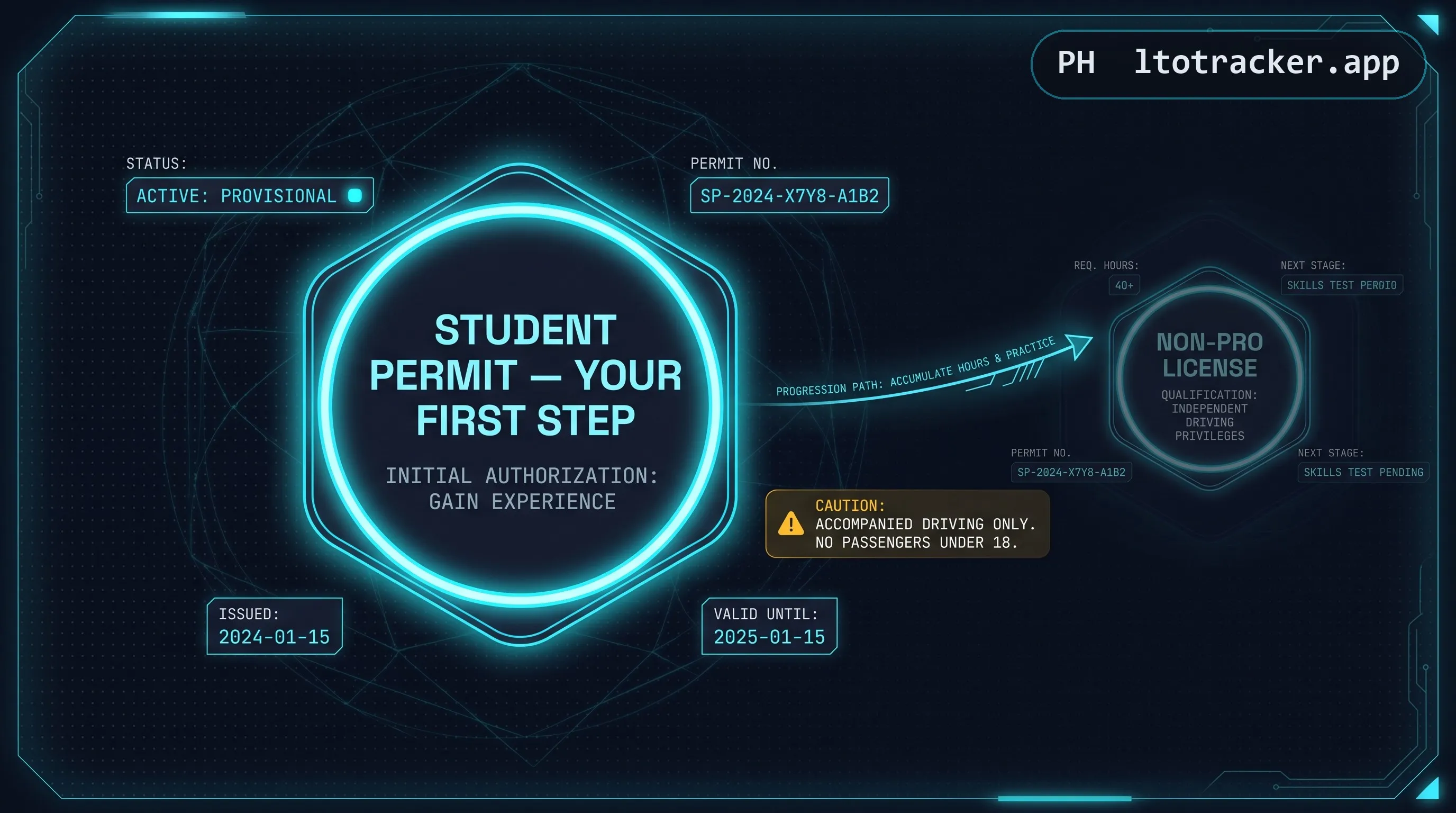
The journey to becoming a legally authorized driver in the Philippines begins with a single, foundational step: securing a student license. Also officially referred to as a Student Driver Permit, this document is not a full license. Instead, it is a restricted authorization granted by the Land Transportation Office that allows a learner to operate a motor vehicle strictly for practice and instructional purposes.
The primary condition of holding a student license is that the learner must be accompanied at all times by a fully licensed driver whenever they are behind the wheel. This accompanying driver must possess a valid non professional or professional driver license with the appropriate restriction code for the vehicle being driven. The rationale behind this strict rule is simple but critical: road safety. Novice drivers need immediate, hands on guidance from experienced individuals to prevent accidents and learn proper traffic etiquette.
Operating a vehicle with a student license without the required licensed companion is a severe traffic violation. If apprehended, the learner faces heavy fines, the immediate confiscation of their student permit, and a potential ban from applying for a non pro or professional license in the future. The Land Transportation Office enforces this regulation rigorously to maintain order on public roads.
A student license has a validity period of precisely one year from the date of its issuance. It is entirely within this one year window that the learner is expected to practice their driving skills, complete their practical driving course, and apply for a non professional license. If the student license expires before the holder transitions to a non pro license, they must reapply for a completely new student permit from scratch, repeating the entire application process and paying the fees again.
Complete Student License Requirements
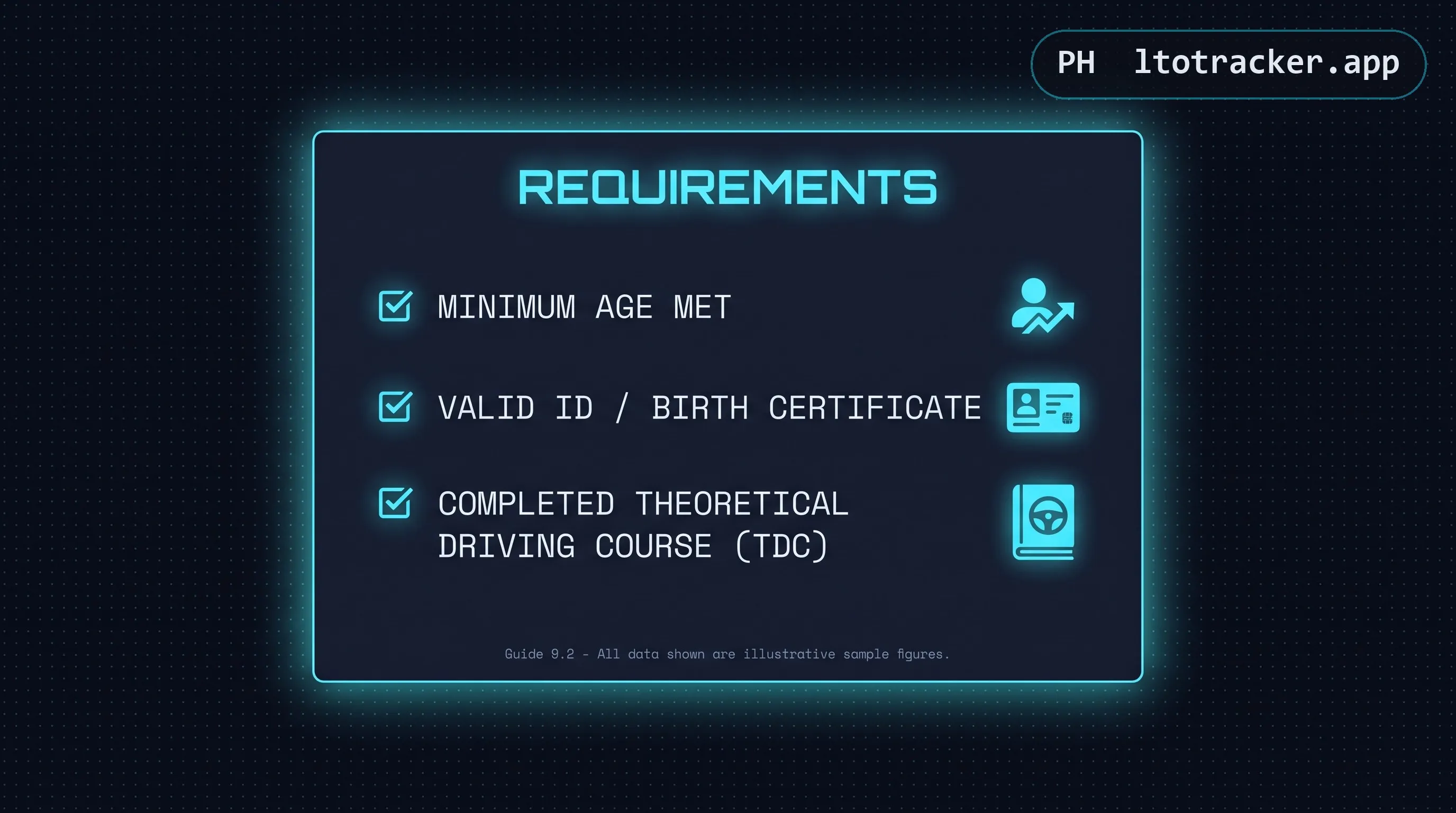
Before you can even step inside an LTO branch to apply, you must gather a comprehensive set of documents. The Land Transportation Office has modernized its procedures, meaning many of the student license requirements now involve electronic certificates transmitted directly to their central database.
The most crucial of the student license requirements is the Theoretical Driving Course certificate. Often abbreviated as TDC, this course involves a minimum of fifteen hours of classroom or online instruction covering Philippine traffic laws, road signs, right of way rules, and defensive driving concepts. You must enroll in an LTO accredited driving school to take this course. Upon passing the final assessment of the TDC, the driving school will electronically upload your completion certificate to the LTO system.
Age is a fundamental qualifying factor. To apply for a student license, you must be at least sixteen years old. If you are exactly sixteen or seventeen, you fall under the minor category. Minors face additional student license requirements. Specifically, they must present a notarized letter of consent signed by a parent or legal guardian. This letter must explicitly state that the guardian allows the minor to apply for a student permit and learn how to drive. Additionally, the minor must bring a photocopy of the consenting guardian valid government issued identification card bearing their signature.
Proof of identity and citizenship is also mandatory. Filipino citizens must present an original copy of their Certificate of Live Birth issued by the Philippine Statistics Authority. If a PSA birth certificate is unavailable, a valid Philippine passport is an acceptable substitute. If you are a married woman who has adopted your husband surname, you must also provide your original PSA marriage certificate to validate the name change.
A medical certificate is the final major piece of the puzzle. You must undergo a physical examination at a medical clinic that is officially accredited by the Land Transportation Office. The examining physician will assess your vision, hearing, and overall physical capacity to ensure you are medically fit to learn how to drive. Similar to the TDC certificate, the clinic will transmit your medical evaluation results electronically to the LTO database, though you should always request a hard copy for your personal records.
Do not forget to download and completely fill out the official Application for Driver License form. Having this form filled out beforehand saves you precious time at the LTO branch. Also, ensure you have your Tax Identification Number handy, as the LTO often requires it for their records during the application process.
How to Get Student Permit: The LTO Process

Knowing how to get student permit applications processed efficiently can save you from spending the entire day at a crowded government office. The process is streamlined, but it requires you to follow the steps in exact order at the LTO licensing center.
The first step is evaluation. Proceed directly to the customer service counter or the designated evaluating window at your chosen LTO branch. Submit your completely filled out application form, your original PSA birth certificate, your medical certificate, and your printed TDC certificate. If you are a minor, submit the notarized consent letter and the guardian ID photocopy as well. The evaluating officer will thoroughly inspect your documents, cross reference the electronic certificates in the database, and verify that you meet all age and documentary criteria.
Once the evaluating officer approves your application, they will issue a routing slip and direct you to the cashier. Proceed to the payment window and pay the required student permit fee. The fee structure may change slightly depending on LTO memorandums, so bringing extra cash is always a smart idea. After paying the fee, the cashier will issue an official receipt. This receipt is an important document; keep it secure as you will need it for the next steps and for future LTO transactions.
Following payment, you will wait for your name to be called at the biometric encoding section. An LTO encoder will take your digital photograph, capture your electronic signature on a digital pad, and scan your fingerprints. It is important to dress appropriately for this step. The LTO implements a strict dress code: sleeveless shirts, plunging necklines, and short shorts are explicitly prohibited. You will also be asked to remove hats, sunglasses, and excessive facial piercings for the photograph.
After the biometric data is captured and saved to your profile in the central database, you simply need to wait for the release of your permit. Unlike a non pro license which requires written and practical examinations on site, the student permit is granted solely based on the fulfillment of the documentary and educational requirements. You will be called to the releasing window where an LTO officer will hand you your official Student Driver Permit, usually printed on a specialized secure paper rather than a plastic card.
Always verify the details printed on your student permit before leaving the releasing window. Check the spelling of your name, your date of birth, and your address. If you spot any typographical errors, inform the releasing officer immediately so the corrections can be made in the database before the record becomes permanent.
The Critical Role of the Theoretical Driving Course
The introduction of the mandatory Theoretical Driving Course fundamentally changed how to get student permit approvals in the Philippines. Before the TDC mandate, applying for a student license was almost entirely an administrative process requiring little to no prior knowledge of driving laws. This lack of foundational education contributed to a culture of undisciplined driving and frequent road accidents.
The Land Transportation Office instituted the TDC requirement to address this critical gap in driver education. The fifteen hour course serves as the academic bedrock for every new driver. It is designed to instill a deep understanding of traffic rules and regulations before a learner is even allowed to touch a steering wheel. The curriculum is comprehensive, covering the intricate details of road signs, pavement markings, and the vital concept of right of way at intersections.
Beyond just memorizing rules, the TDC heavily emphasizes defensive driving. Instructors teach learners how to anticipate potential hazards on the road, how to maintain safe following distances, and how to react appropriately to unpredictable actions by other motorists or pedestrians. The course also includes modules on road courtesy, the ethical responsibilities of a driver, and the specific penalties associated with various traffic violations.
You cannot simply sit through the fifteen hours and automatically receive a certificate. The TDC concludes with a rigorous final written examination administered by the driving school. You must pass this exam to prove you have absorbed the material. Only upon passing will the school transmit your completion status to the LTO database, allowing you to proceed with your student license application.
From Student License to Non Pro License
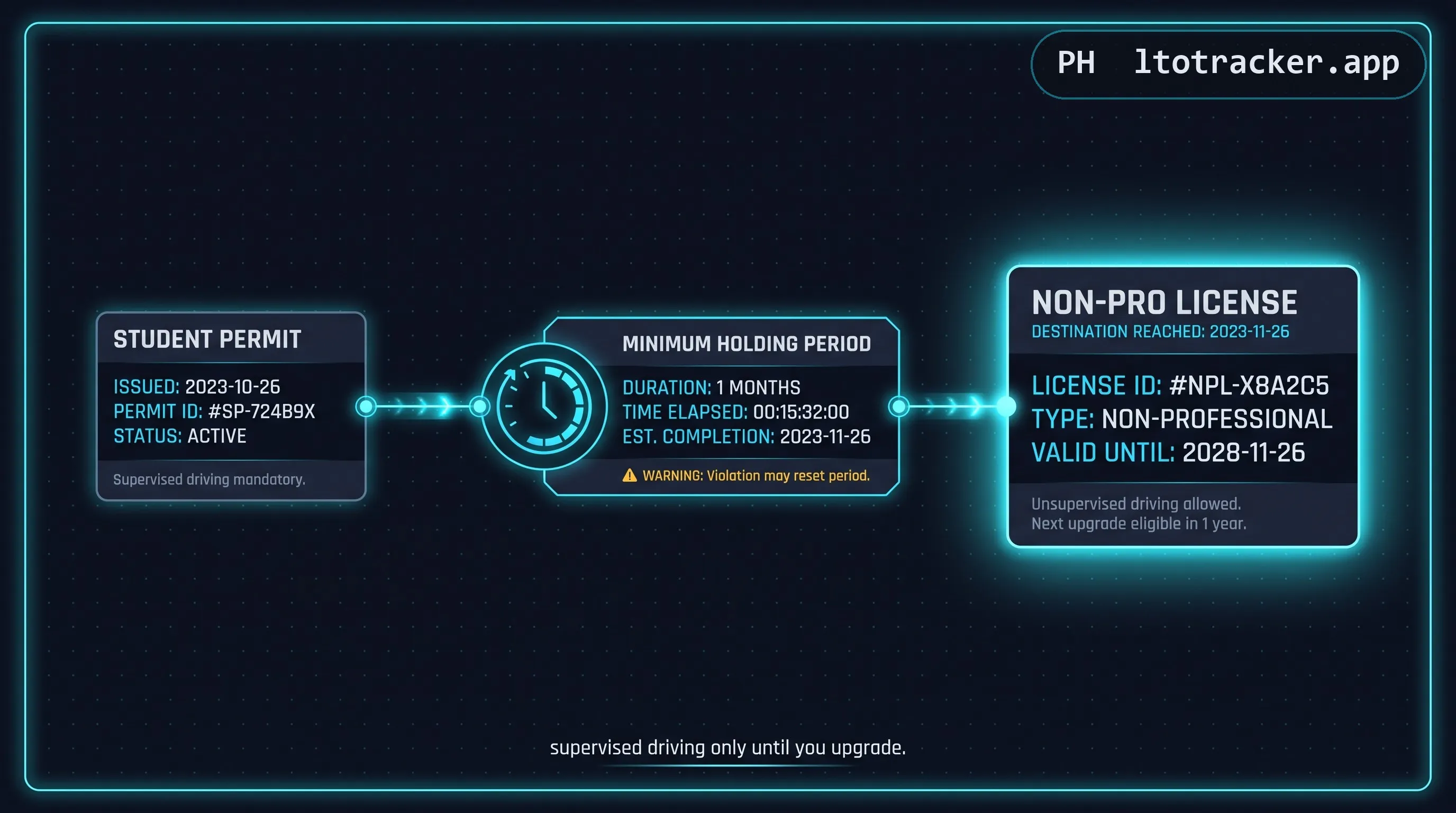
Your student license is a temporary stepping stone. Its ultimate purpose is to provide you with a legal framework to practice driving so that you can eventually apply for a non professional driver license. You must hold your student permit for a minimum of thirty one days from its date of issuance before the LTO will even allow you to apply for a non pro license.
During this thirty one day holding period, you are expected to enroll in a Practical Driving Course at an accredited driving school. While the TDC provided the academic foundation, the PDC provides the crucial hands on experience. You will learn how to operate the vehicle controls, perform parking maneuvers, and navigate actual traffic under the close supervision of a professional instructor.
Remember that your student license is only valid for one year. You must complete your PDC, pass the LTO written examination, and pass the LTO practical driving test before that one year expires. If your student permit expires, all your progress resets. You will be forced to apply for a new student permit, pay the fees again, and restart the waiting period. Therefore, it is highly recommended to plan your driving lessons efficiently and schedule your non pro license application well within the one year validity window.
Obtaining a student license is a straightforward process when you are fully prepared. By understanding exactly how to get student permit approvals and diligently gathering all the mandatory student license requirements, you set yourself up for a smooth transition from an absolute beginner to a responsible, fully licensed driver on Philippine roads.